A login form is the most-copied, least-reviewed piece of PHP on the internet. Someone needs auth, they paste a tutorial from 2014, it "works," and it ships. Then it leaks.
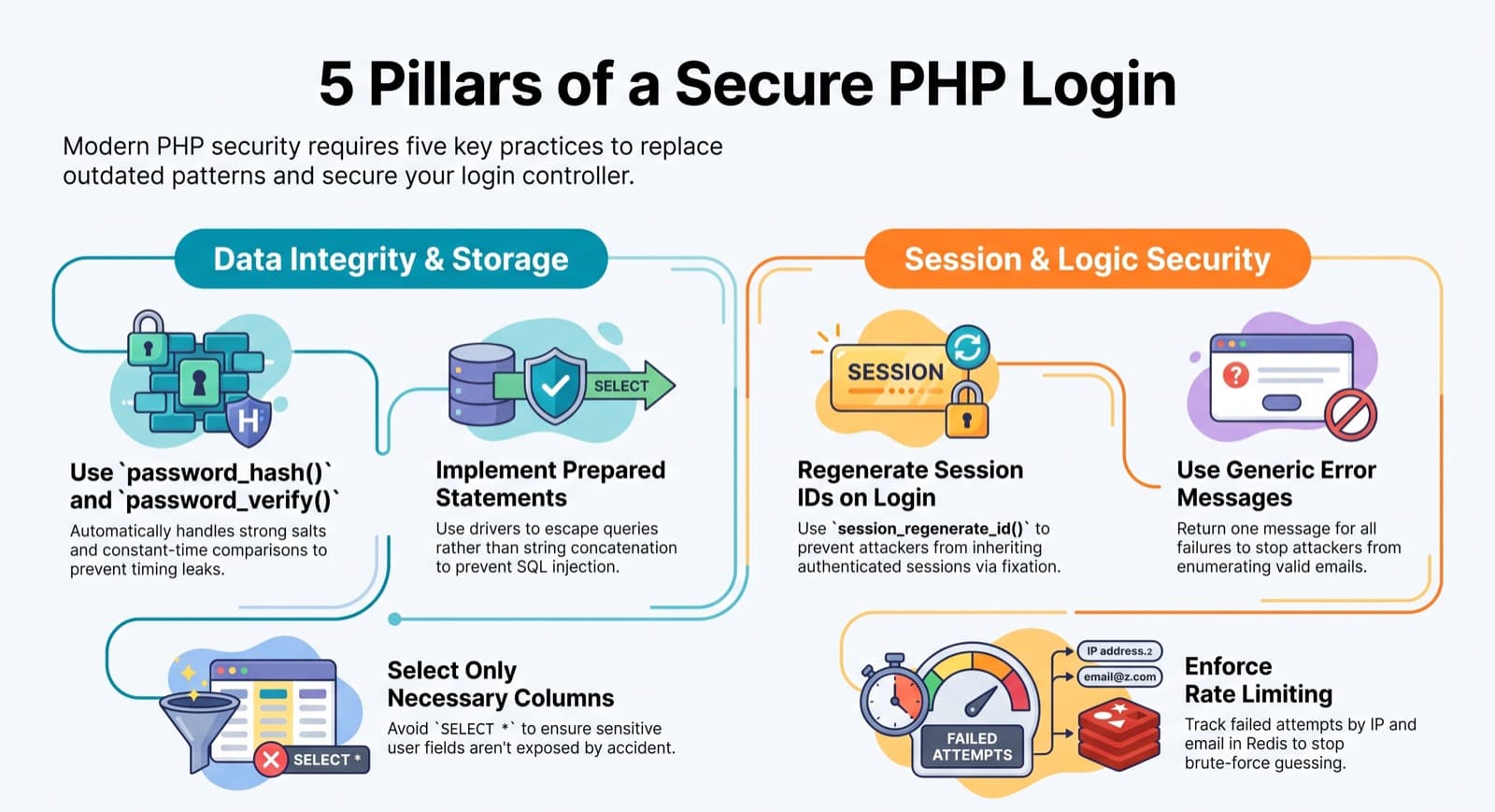
I've reviewed a lot of these. The same five mistakes show up every time. None of them are exotic. All of them are one function call away from being fixed.
1. Hashing passwords by hand
If your code contains md5(), sha1(), or a salt you generated yourself, stop. PHP has had a real password API since 5.5.
// On signup
$hash = password_hash($password, PASSWORD_DEFAULT);

// On login
if (password_verify($password, $hash)) {
    // authenticated
}
password_hash() picks a strong algorithm (bcrypt by default, Argon2id if you pass PASSWORD_ARGON2ID), generates the salt for you, and stores the cost inside the hash string. password_verify() does a constant-time comparison, so you don't leak timing. You never handle a salt again.
When you raise the cost later, password_needs_rehash() lets you re-hash transparently on the user's next login.
2. Building the query with string concatenation
// Don't
$sql = "SELECT * FROM users WHERE email = '$email'";
That's SQL injection, on the front door of your app. Use a prepared statement and let the driver escape:
$stmt = $pdo->prepare('SELECT id, password_hash FROM users WHERE email = ?');
$stmt->execute([$email]);
$user = $stmt->fetch();
Select only the columns you need. SELECT * on a user row pulls fields you'll expose by accident later.
3. Not regenerating the session ID
This one is invisible until someone exploits it. If you attach the logged-in state to the same session ID the visitor arrived with, you're open to session fixation: an attacker who can plant a victim's session ID before login inherits the authenticated session after.
One line, right after the password checks out:
session_regenerate_id(true);
$_SESSION['user_id'] = $user['id'];
Regenerate on login, and again on logout and any privilege change.
4. Telling attackers which half they got right
// Leaks which emails exist
if (!$user) {
    echo 'No account with that email';
} elseif (!password_verify($password, $user['password_hash'])) {
    echo 'Wrong password';
}
Two different messages turn your login form into a user-enumeration oracle. An attacker scripts it to learn which emails are registered, then focuses on those.
Return one message for both cases:
if (!$user || !password_verify($password, $user['password_hash'])) {
    $error = 'Invalid email or password';
}
To close the timing gap when the user doesn't exist, verify against a dummy hash so both paths do the same work.
5. Letting them guess forever
password_hash() is deliberately slow, which buys you a lot. It does not stop someone running a few hundred guesses at one account. That needs rate limiting.
The cheap version: count failed attempts per email and per IP in a fast store (Redis, or an indexed table), then refuse or delay past a threshold. Reset the counter on success.
You don't need a library to start. You need a counter and a ceiling.
The shape of a correct login
Put together, the whole thing is short:
$stmt = $pdo->prepare('SELECT id, password_hash FROM users WHERE email = ?');
$stmt->execute([$email]);
$user = $stmt->fetch();

if (!$user || !password_verify($password, $user['password_hash'])) {
    // generic error, bump the rate-limit counter
    return $this->fail('Invalid email or password');
}

session_regenerate_id(true);
$_SESSION['user_id'] = (int) $user['id'];
No custom crypto. No string-built SQL. One error message. A fresh session. A counter on top.
None of this is new. password_hash() landed in PHP 5.5, prepared statements are older still, and session_regenerate_id() has been there the whole time. The tools are old and boring. The mistakes survive because the tutorials never caught up.
If you maintain a PHP app with hand-rolled auth, read your login controller today. The fix is usually five small edits, not a rewrite.