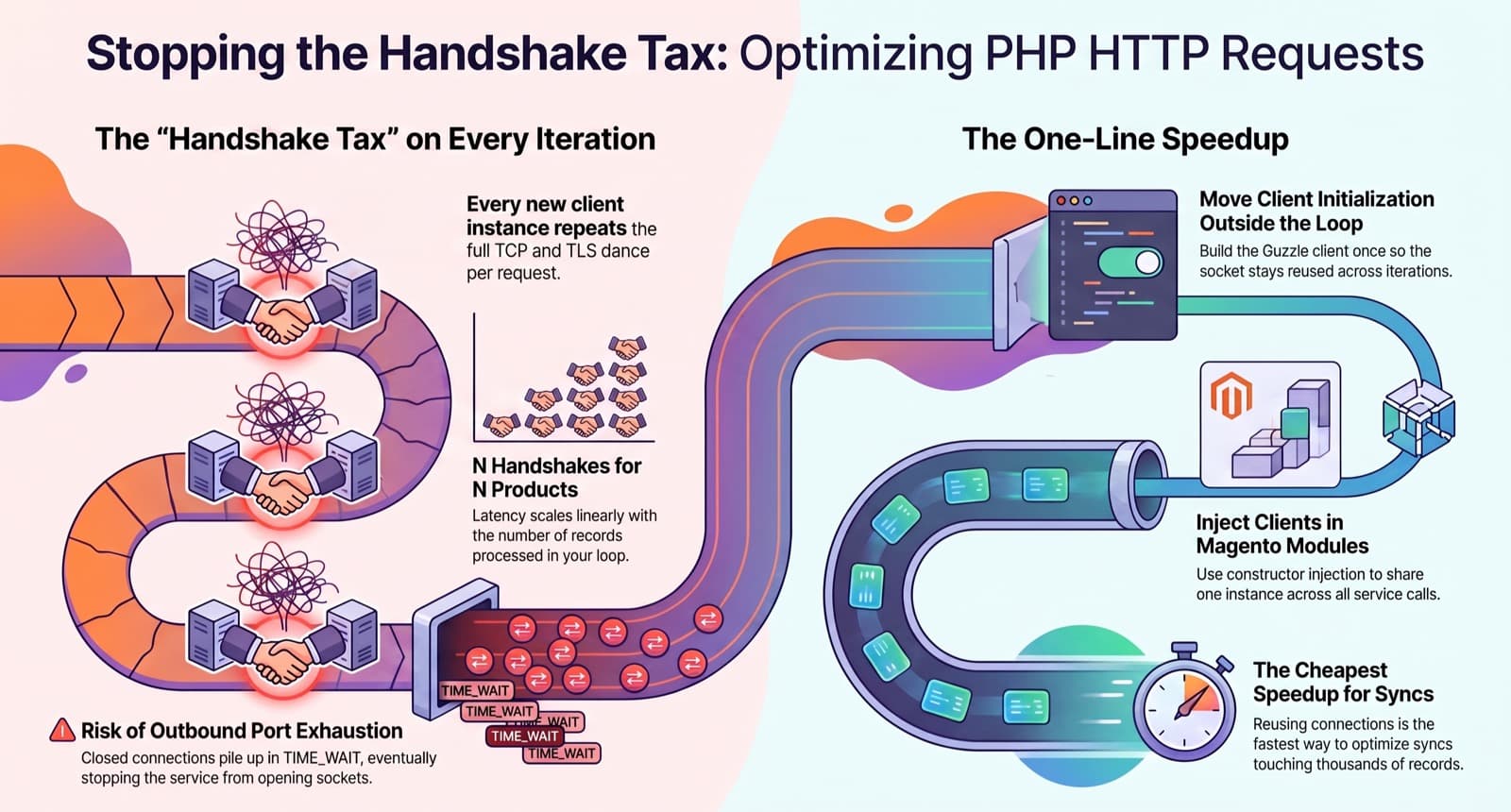
I had a product export that talked to a third-party pricing API. One product, fast. The full catalog was painfully slow. The database was barely doing anything, so I went looking, and the profiler pointed somewhere I didn't expect: the network, before a single request was even sent.
The code created a fresh HTTP client on every iteration of the loop.
The handshake tax
Before you send one byte of an HTTPS request, the machine does a lot of quiet work.
A TCP handshake to open the socket. Then a TLS handshake on top: certificate exchange, key negotiation, several round trips across the wire. Only after all of that does your actual GET or POST go out.
Do it once and reuse the connection, you pay that tax once. Do it inside a loop over 40,000 products, you pay it 40,000 times. The request bodies are tiny. The setup is the whole bill.
PHP tricks you into it
PHP is share-nothing. Every web request starts cold, so it feels natural to build a client, use it, and throw it away. For a single web request that hits one API once, that's fine. You were going to pay one handshake anyway.
The trap is the long-running process. A cron job, a bin/magento console command, a message-queue consumer syncing records to an ERP or a PIM. Those loop. And inside the loop, a lot of Magento integration code looks like this:
foreach ($products as $product) {
    $client = new \GuzzleHttp\Client();   // new connection every time
    $client->post('https://api.example.com/sync', [
        'json' => $this->toPayload($product),
    ]);
}
Every iteration opens a new connection, runs the full TCP + TLS dance, sends a few hundred bytes, and tears the connection down. The handshake runs N times for N products.
Reuse one client
Guzzle keeps the underlying connection alive between requests made on the same client instance. So build it once, outside the loop:
$client = new \GuzzleHttp\Client([
    'base_uri' => 'https://api.example.com',
    'headers'  => ['Connection' => 'keep-alive'],
]);

foreach ($products as $product) {
    $client->post('/sync', ['json' => $this->toPayload($product)]);
}
Same requests, same payloads. But now the socket and the TLS session are reused across the loop. You handshake once, then stream the rest over the open connection.
In a Magento module, go one step further and don't new the client at all. Inject a configured client, or a small wrapper service, through the constructor. The same instance gets shared, and the connection survives across the calls that matter.
The louder version
In a long-lived runtime the same mistake gets worse. Create a client per call in a hot path and the cost compounds: on top of the repeated handshakes, you can run the machine out of outbound ports, because closed connections pile up in TIME_WAIT faster than the OS reclaims them. The service stops being able to open new sockets at all. Same root cause, much louder failure.
PHP's request model usually saves you from that specific cliff. It does not save you from the latency.
How to find it
Grep your integration code for clients built inside loops, or hidden in a method that runs once per record:
grep -rn "new .*Client(" app/code | grep -i httpLook for any new \GuzzleHttp\Client() (or a raw curl_init()) sitting inside a foreach. That's the line paying the handshake tax on every pass.
Move the client up, out of the loop, and let the connection stay open. It's a one-line change. On a sync that touches thousands of records, it's the cheapest speedup you'll find all day.